
INTELLIGENCE / ORBITAL ENVIRONMENT
The Orbital Environment
An educational guide to space debris and orbital sustainability, built on official ESA statistics and definitions. kededro does not operate a satellite-tracking network or a collision-prediction service — this page explains the domain and attributes every figure to its source.
The environment in numbers
Objects regularly tracked and catalogued
OBSERVED≈ 47,020objects
Maintained in space surveillance network catalogues.
Source: ESA Space Environment Statistics (DISCOSweb)
Observation date: 09 October 2026 (ESA page update)
Retrieved: 11 October 2026 (kededro verification)
Update frequency: Periodic
Modelled objects larger than 10 cm
MODELLED≈ 68,450objects
MASTER-8 statistical model, reference population 02/2026 — including ≈ 11,300 active payloads.
Source: ESA Space Environment Statistics (DISCOSweb)
Observation date: 09 October 2026 (ESA page update)
Retrieved: 11 October 2026 (kededro verification)
Update frequency: Periodic
Modelled objects 1 cm to 10 cm
MODELLED≈ 1.5 millionobjects
Statistical estimate — most are too small to track individually.
Source: ESA Space Environment Statistics (DISCOSweb)
Observation date: 09 October 2026 (ESA page update)
Retrieved: 11 October 2026 (kededro verification)
Update frequency: Periodic
Modelled objects 1 mm to 1 cm
MODELLED≈ 230 millionobjects
Statistical estimate of the smallest hazardous fragments.
Source: ESA Space Environment Statistics (DISCOSweb)
Observation date: 09 October 2026 (ESA page update)
Retrieved: 11 October 2026 (kededro verification)
Update frequency: Periodic
“Observed” figures are actual catalogued counts; “modelled” figures are statistical estimates from ESA’s MASTER model and must not be read as tracked objects.
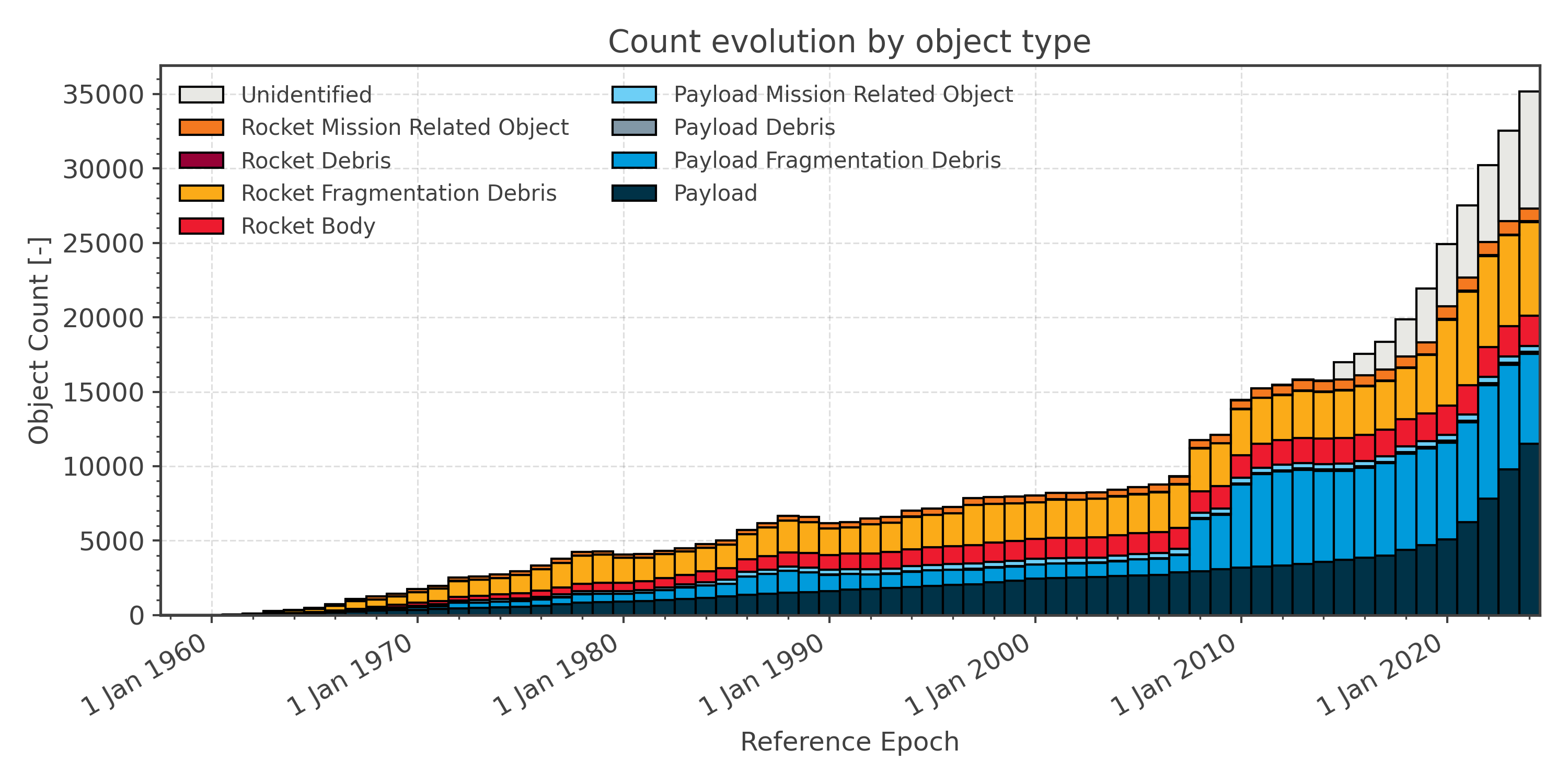
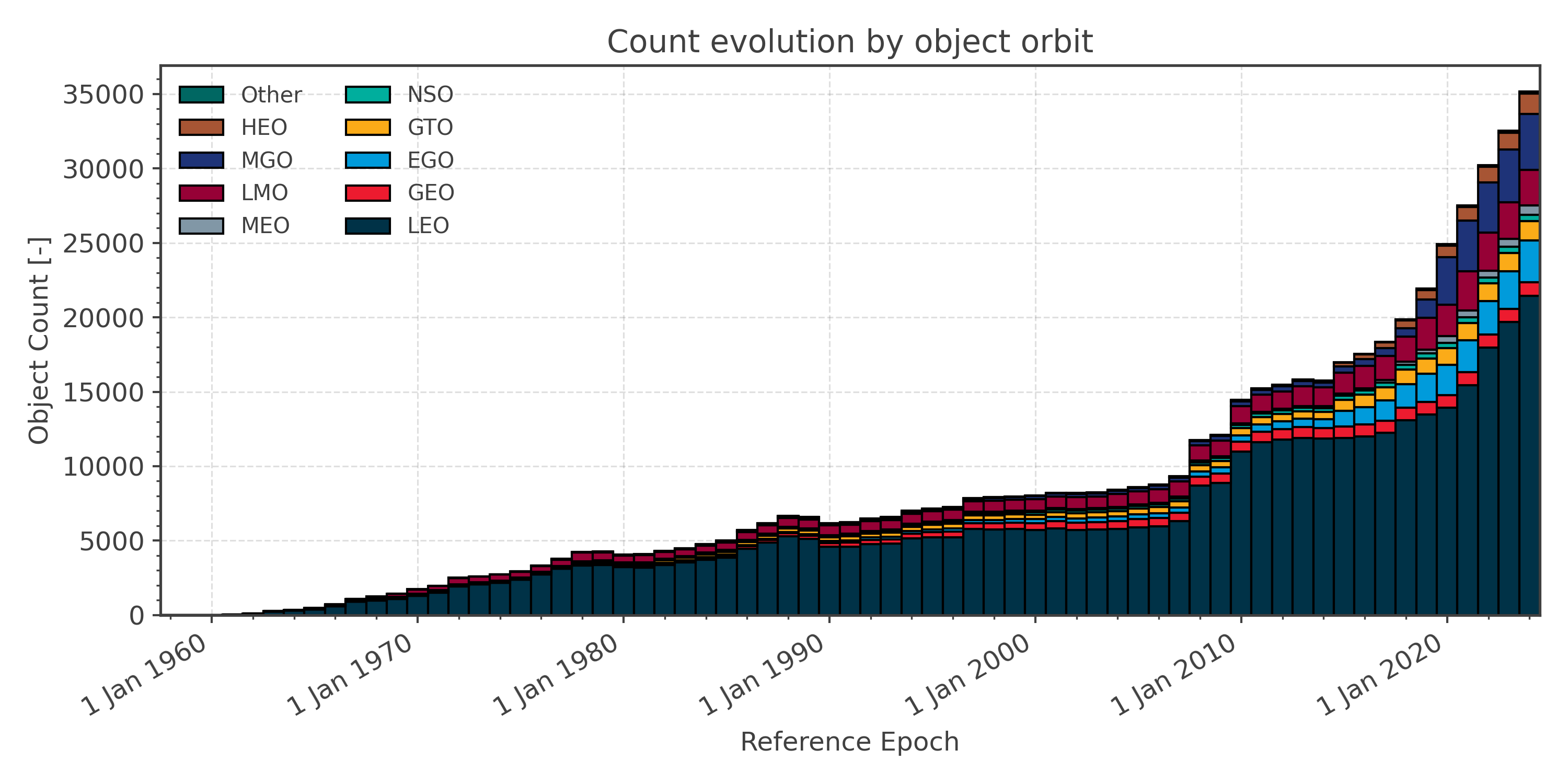
ESA official trend charts
Historical trends, shown directly from ESA’s published statistics page.
Understanding the domain
What orbital debris is
Orbital debris (space debris) is any non-functional artificial object in Earth orbit or re-entering the atmosphere — retired satellites, spent rocket stages, mission-related objects such as lens covers, and fragments from break-ups. ESA adopts the IADC definition: artificial objects in orbit or re-entering that are non-functional.
Why debris threatens spacecraft
In orbit, relative impact speeds routinely reach 10 km/s or more. At those speeds a paint fleck can pit a window, a 1 cm fragment carries the energy of a hand grenade, and a 10 cm object can destroy a satellite. Even sub-centimetre impacts degrade solar panels and optics over a mission life.
How objects are tracked
Space surveillance networks — combining radars, telescopes and, in some systems, space-based sensors — detect and track objects, maintaining catalogues of orbital elements. ESA’s DISCOS-based statistics count roughly 47,000 objects regularly tracked and catalogued; statistical models estimate far more small fragments that are too small to track.
Why conjunction assessment matters
Conjunction assessment compares predicted orbits of two objects to estimate close-approach risk. Because orbits are only known with limited precision, operators evaluate probability of collision, not certainty, and monitor conjunctions repeatedly as predictions refine.
What collision avoidance means
When a conjunction risk exceeds an operator’s threshold, the satellite performs an avoidance manoeuvre — a small burn that shifts the predicted miss distance. Operators of large constellations perform these routinely; each manoeuvre costs propellant, which limits mission life.
How end-of-life disposal works
International guidelines call for post-mission disposal: LEO satellites should deorbit or move to a disposal orbit within 25 years of end of mission (many operators now commit to far less), GEO spacecraft should ascend to a graveyard orbit above the geostationary ring, and stored energy (batteries, propellant) should be passivated to prevent break-ups.
How debris mitigation supports space sustainability
Mitigation measures — designing for demise, passivation, controlled re-entry, debris-release prevention and post-mission disposal — slow the growth of the debris population. They are codified in the IADC guidelines and national regulations. Sustainability also depends on choosing orbits responsibly and sharing conjunction data.
What active debris removal aims to accomplish
Because mitigation alone does not remove existing debris, active debris removal (ADR) concepts study capturing and deorbiting large defunct objects — with robotic arms, nets, harpoons or drag augmentation. Multiple ADR demonstration missions are in development worldwide; none yet operate at scale.
KEDEDRO OUTLOOK — CONCEPT / PLANNED, NOT AN OPERATING CAPABILITY
These subjects inform kededro’s future space-awareness research: understanding debris populations, conjunction-risk concepts and sustainability practices is foundational knowledge for any future orbital work, from satellite mission planning to responsible disposal design. This is an educational and research-direction statement — kededro currently operates no tracking network, catalogue or collision-prediction service, and none should be inferred from this page.
Sources
- ESA Space Environment Statistics — European Space Agency Space Debris Office.
- ESA Space Environment Report — annual environment report (tenth edition released 01/05/2026).
- IADC Space Debris Mitigation Guidelines — Inter-Agency Space Debris Coordination Committee.